[wpws url=”http://blog.disasterrecovery.org” query=”#recent-posts-2″ ]
Business Continuity Planning
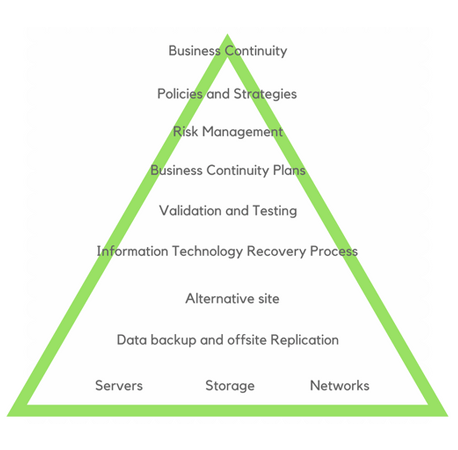
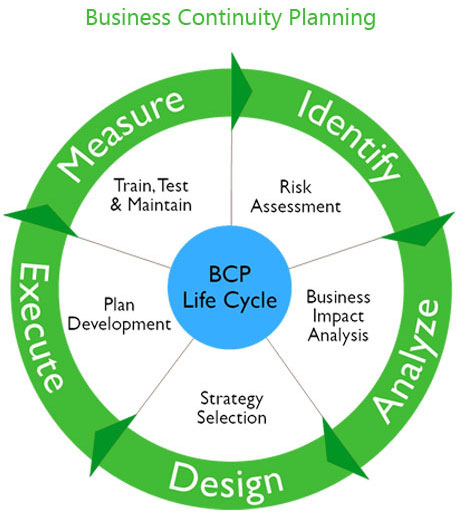
Business continuity planning is an enterprise's strategic framework for responding to natural and manmade disasters. The design and execution of the plan is collectively outlined by the management and leadership teams in line with the organization's resiliency objectives. The nature, magnitude and complexity of business operations are gauged. A wide range of risk factors that can disrupt processes are assessed. These business continuity threats depend on a variety of elements such as
A contextually relevant crisis plan is then designed that gives the enterprise a working model for transitioning the emergency situation and effectuating business continuity. Designing an effective plan is more often than not limited by constraints such as budget, technology, infrastructure, assets and availability of skilled personnel with the necessary expertise.
An important part of an effective business continuity plan has to do with identifying the company's mission critical deliverables and prioritizing their respective mitigation, recovery and restoration plans. Since commercial enterprises operate in a continuously transforming business ecosystem that is constantly exposed to change, organizations must regularly update their emergency systems through a culture of testing, drills and simulation exercises in order to ensure that their strategies don't become obsolete over a period of time.
Disaster Recovery
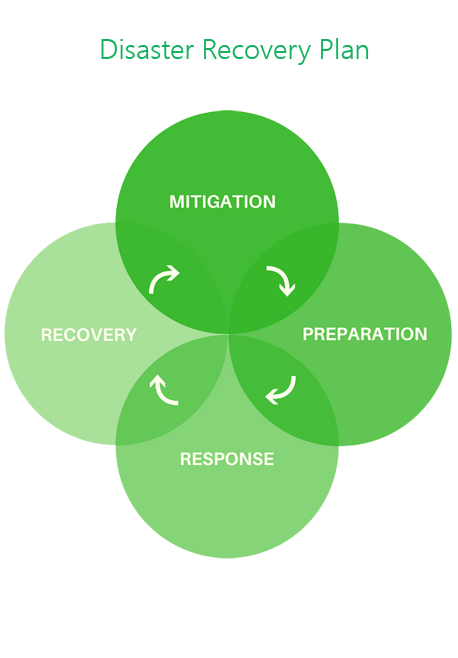
Disaster recovery is an organization's response strategy to a natural or manmade disaster. In many cases, the impact of a crisis situation, such as a massive earthquake, a category 5 cyclone or a terrorist operation of devastating proportions - are unavoidable owing to the sheer intensity of the hazard. Health & safety takes priority in such cases. From a commercial perspective, backups of data and business plans and the minimization of damage on assets and property take precedence. The magnitude of damage can be greatly reduced if an organization's emergency team proactively takes into consideration the possibility of such occurrences while designing their infrastructure.
Execution becomes vital when disaster strikes as rescue teams have very limited timeframes for completing key tasks. Emergency teams often rehearse their disaster recovery plans in simulated environments to work out the practicalities of strategies. Roles and responsibilities must be a logical extension of the personnel's mainstream job profile. A detailed documentation of activities and procedures to be deployed gives emergency teams a reliable point of reference for knowledge transfer. Enterprises can also seamlessly transition manpower related issues such as attrition and training of new staff.
Structurally, disaster recovery plans are highly flexible so that rescue and restoration efforts can be improvised and adapted to unexpected developments. This is essential as any hazardous occurrence is erratic by nature and the variables that influence its progression can never be accurately forecasted.
BC / DR Plan Steps
- Analyze the need for a plan that makes business operations more resilient
- Assess the feasibility of investing in a business continuity and disaster recovery strategy in terms of time, effort, resources, assets, infrastructure and budget
- Identify the mission critical operations that need to be given preference
- Establish the extent to which the plan can mitigate damage and restore operations
- Identify interdependent tasks and workflows within the organization and processes that are dependent on external entities such as vendors, associates and so on
- Establish time frames within which systems and processes must be restored
- Design a business continuity and disaster recovery plan
- Implement the plan
- Test the effectiveness and efficiency of the plan through drills and simulated exercises
- Revisit the plan design and make the necessary changes based on the information gathered during the testing phase
- Maintain the plan through regular updates and enhancements